Audio alignment
SpectrogramGuidedAligner turns a transcript and the
speech that says it into one AudioSegment per token.
Segments are the unit an audio explanation masks, so a cut must not split a sound:
the aligner places each boundary at the quietest, steadiest point near the gap
between two words.
Install
pip install "mllm-shap[audio,transformers]"
The audio extra decodes audio (soundfile) and refines boundaries
(librosa); the transformers extra runs the default Wav2Vec2 model.
Align a transcript
from pathlib import Path

from mllm_shap import AudioPart
from mllm_shap.alignment import SpectrogramGuidedAligner, Wav2Vec2Ctc

model = Wav2Vec2Ctc("facebook/wav2vec2-base-960h", revision="main", device="cpu")
aligner = SpectrogramGuidedAligner(model)
audio = AudioPart(Path("speech.wav"), sample_rate=16000)
for segment in aligner.align("I had that curiosity beside me", audio):
    print(segment.token, round(segment.start_time, 2), round(segment.end_time, 2))
align accepts a string (split on whitespace) or a list of tokens. A token with
no character the model can spell, such as a dash, gets no segment.
attach_audio=True stores each segment’s samples as WAV bytes in
segment.audio.
How it works
The CTC (connectionist temporal classification) model scores every audio frame.
A Viterbi pass aligns the transcript’s characters to frames in order, with the model’s word separator between tokens.
A token spans its first to last character. Each boundary then moves, within the gap between two tokens, to the minimum of
energy_weight * rms + flux_weight * flux: the normalised RMS (root mean square) energy and spectral flux of the waveform. The first and last edges search 80 ms around their rough position.A boundary moves only when that point is quiet (RMS at most half the window’s mean);
AudioSegment.boundary_refinedsays whether both edges moved.
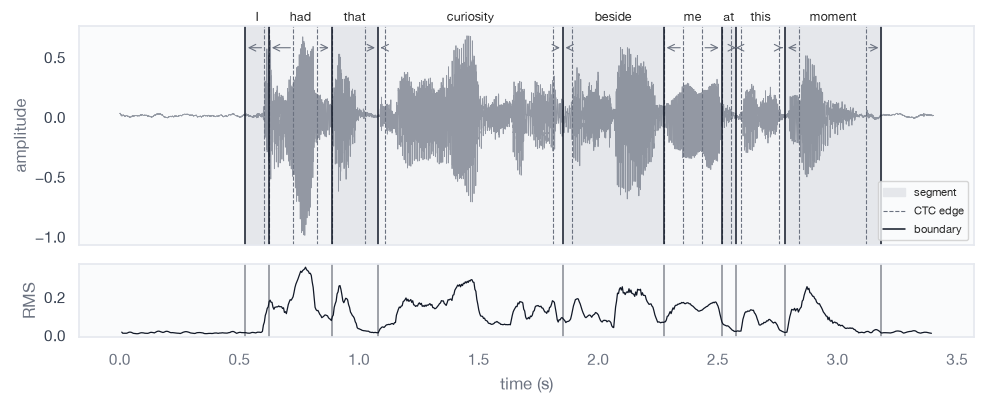
Nine words of a recorded sentence. Dashed lines are the rough CTC edges, arrows show where refinement moved them, solid lines are the final boundaries; each lands in a dip of the RMS energy (bottom). Between “curiosity” and “beside” the speech never goes quiet, so that boundary stays.
With energy_weight=0, flux_weight=1 the cuts follow spectral change instead
of energy: a few move by 10 to 40 ms, and only 1 of the 9 boundaries lands on a
quiet point instead of 7.
plot_audio_segments() (viz extra) draws the waveform with
each segment, the rough CTC edges (ctc_start_time, ctc_end_time) and the
arrows to the refined boundaries, over the RMS energy whose dips the cuts land in;
values colours the segments like attribution renderers do.
Segments last at least 50 ms. Times are in seconds and sample indices refer to the audio’s own sample rate.
Audio players
explanation.players: sgpa_segments
(SgpaSegmentPartitioner) makes each spoken word a player. A
message qualifies when it holds an AudioPart and its transcript
as text; other messages add no players. Each player’s
PlayerSpan covers the word in the transcript and, in
samples, its stretch of audio, so the absence policies mask both: delete
cuts the absent samples, pad and neutral replace them with silence of the
same length.
from mllm_shap import ExplainConfig, Message, Role, TextPart

spoken = Message(role=Role.USER, content=(TextPart("I had that curiosity"), audio))
config = ExplainConfig.model_validate({
    "backend": {"kind": "mock", "model_id": "stub"},
    "explanation": {
        "players": "sgpa_segments",
        "plugin_options": {"sgpa_segments": {
            "model_id": "facebook/wav2vec2-base-960h", "revision": "main"}},
    },
})
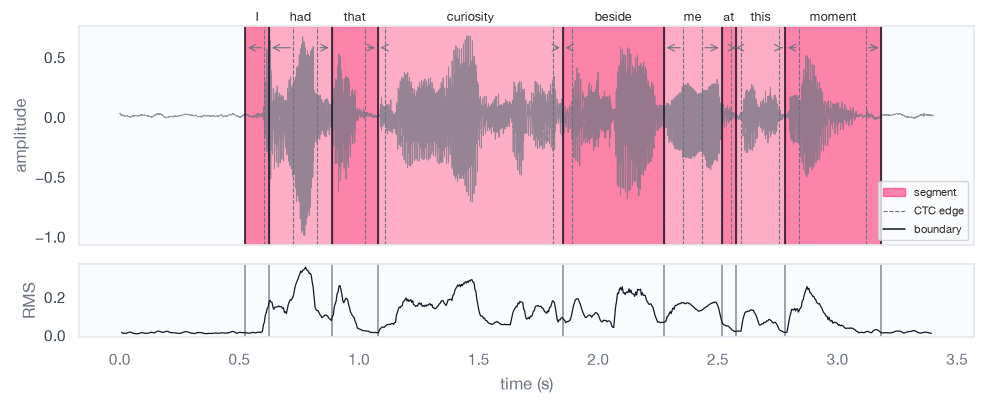
Words as players, coloured by attribution with values. The mock backend
scores every word alike, so the colours are equal here.
Plugin options: model_id, revision, device, energy_weight,
flux_weight, text_roles (roles whose typed messages also give word
players, none by default) and transcript. With transcript: send (default)
the model gets the masked transcript next to the masked audio. With
align_only the transcript only builds the players: every coalition sends the
audio alone, so the values reflect what the model hears, not what it reads.
Backends that hear the masked audio: Audio input.
Other CTC models
Any object with sample_rate, blank_id, vocab and
log_probs(waveform) satisfies CtcModel, for
example another Wav2Vec2 checkpoint for a different language, or a fixed matrix
in tests. Pin revision to a commit hash for reproducible segments.
The Audio alignment with SGPA notebook runs every step on a recorded sentence. The method follows SGPA (spectrogram-guided phonetic alignment), arXiv:2603.02250.