Attribution visualization
Business context: stakeholders rarely accept raw attribution vectors. Coloured words, sorted bars and marked-up audio make Shapley and Banzhaf results legible in compliance reviews and product postmortems.
Goal: explain three inputs with a real model and show every built-in view: a single prompt (words as players), a multi-speaker conversation (messages as players) and a spoken sentence (words of the audio as players).
Prerequisites: uv sync --extra viz --extra transformers --extra audio. The first run downloads Qwen/Qwen2.5-1.5B-Instruct (3.1 GB) and facebook/wav2vec2-base-960h (0.36 GB); a GPU or Apple MPS keeps it to a few minutes.
Expected output: attributions of both signs and different sizes, rendered as coloured text, bar charts, HTML and an audio figure.
from pathlib import Path

import matplotlib.pyplot as plt

from huggingface_hub.utils import disable_progress_bars
from transformers.utils.logging import disable_progress_bar

from mllm_shap import (
    AudioPart,
    CoalitionMask,
    ConversationSnapshot,
    DeletePolicy,
    ExplainConfig,
    ExplainRunner,
    Message,
    Role,
    TextPart,
    TokenBarRenderer,
    TokenTextRenderer,
    TransformersTextBackend,
    Turn,
    display_attribution_html,
    render_attribution,
    render_attribution_html,
)
from mllm_shap.plugins.context import PluginContext
from mllm_shap.viz import plot_audio_segments, plot_conversation, render_conversation_html

# Progress bars render as widgets that plain viewers (VS Code, GitHub) cannot show.
disable_progress_bars()
disable_progress_bar()
One model for three explanations
Each coalition’s 4-token answer is scored with tfidf_cosine against the answer to the full input, so a player earns credit when it moves the answer toward the original and loses credit when it moves it away. The pinned revision keeps the numbers reproducible, the prefix cache reuses shared prompt prefixes, and one backend is loaded once and passed to every runner.
MODEL = {
    "kind": "transformers",
    "model_id": "Qwen/Qwen2.5-1.5B-Instruct",
    "options": {"revision": "989aa7980e4cf806f80c7fef2b1adb7bc71aa306", "dtype": "float16"},
}


SYSTEM = (
    "You are a support assistant for a store. Answer only from the question, in one "
    'short sentence. If it does not give enough information, say "Not enough '
    'information." Never invent policy details and never ask a question.'
)
ROLES = {"tokens": ["user"], "messages": ["user", "assistant"]}  # the system prompt is no player


def config(**explanation: object) -> ExplainConfig:
    players = explanation.get("players", "tokens")
    roles = {players: {"roles": ROLES[players]}} if players in ROLES else {}
    return ExplainConfig.model_validate({
        "backend": MODEL,
        "generation": {"max_new_tokens": 4},
        "explanation": {
            "value_fn": "tfidf_cosine",
            "absence_policy": "delete",
            "kv_cache": {"enabled": True},
            "archive": {"path": ""},
            "plugin_options": roles,
            **explanation,
        },
    })


backend = TransformersTextBackend(PluginContext(config=config()))
async def answers_without(output, snapshot) -> None:
    """Print the answer to the full input and to the input without each player."""
    generation = config().generation
    answer = await backend.generate(snapshot, generation)
    print(f"{'full input':>28} -> {answer.text!r}")
    players = output.player_set
    for index, span in enumerate(players.spans):
        mask = CoalitionMask.from_sequence(
            tuple(other != index for other in range(players.num_players))
        )
        absent = DeletePolicy().apply(snapshot, players, mask)
        answer = await backend.generate(absent, generation)
        print(f"{'without ' + span.display_label[:20]:>28} -> {answer.text!r}")


def show(output) -> None:
    for span, value in zip(output.player_set.spans, output.result.values, strict=True):
        print(f"{span.display_label[:44]:44} {value:+.3f}")
    print("sum", round(sum(output.result.values), 4), "= grand - base",
          round(output.result.grand_value - output.result.base_value, 4))
Words of a single prompt
Business: a support assistant is asked about a refund for a broken laptop that the customer already opened; reviewers want to see which words drive the answer.
Technical: 13 word players, complementary contributions with a budget of 160 evaluations (exact enumeration would need 8192).
prompt = ConversationSnapshot.from_turns((
    Turn(messages=(
        Message(role=Role.SYSTEM, text=SYSTEM),
        Message(
            role=Role.USER,
            text="The laptop arrived broken but I opened it. Refund? Answer yes or no.",
        ),
    )),
))
words = await ExplainRunner(
    config(estimator="complementary", budget={"evaluations": 160}), backend=backend
).explain(prompt)
show(words)
The                                          -0.053
laptop                                       -0.020
arrived                                      +0.020
broken                                       +0.142
but                                          +0.151
I                                            +0.001
opened                                       +0.031
it.                                          +0.149
Refund?                                      -0.081
Answer                                       +0.091
yes                                          +0.253
or                                           +0.029
no.                                          +0.253
sum 0.9656 = grand - base 1.0
await answers_without(words, prompt)
                  full input -> 'Yes.'
                 without The -> 'Yes.'
              without laptop -> 'Yes.'
             without arrived -> 'Not enough information.'
              without broken -> 'Not enough information.'
                 without but -> 'Yes'
                   without I -> 'Yes.'
              without opened -> 'No.'
                 without it. -> 'No.'
             without Refund? -> 'Yes.'
              without Answer -> 'Not enough information.'
                 without yes -> 'Not enough information.'
                  without or -> 'Yes.'
                 without no. -> 'Yes'
The answers above explain the values. Dropping yes or no. makes the model say “Not enough information.” (the largest values, +0.25 each), as does dropping broken or arrived. Dropping opened or it. flips the answer to “No.”: the opened box is what tips it. The values add up to grand_value - base_value up to sampling error.
Coloured words and bars
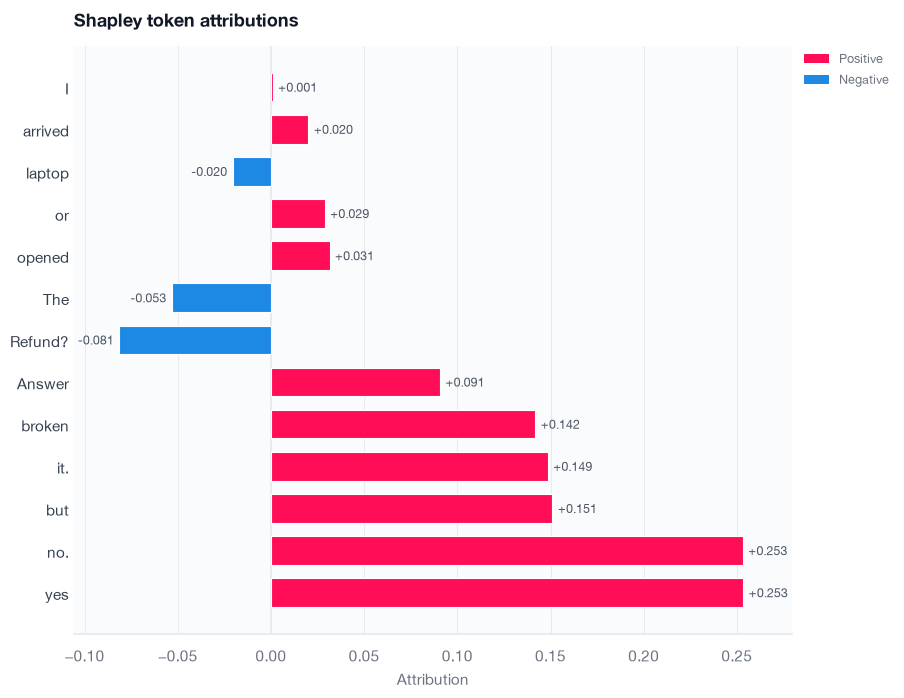
render_attribution returns a matplotlib figure; pass the run’s player_set so labels match the players. Red marks positive values, blue negative ones, and the colour intensity follows the size. token_bar sorts the players by absolute value.
render_attribution(words, prompt, words.player_set, renderer="token_text")
plt.show()
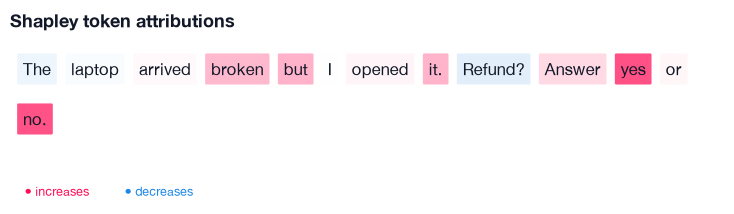
render_attribution(words, prompt, words.player_set, renderer="token_bar")
plt.show()
HTML
In Jupyter, display_attribution_html shows the coloured words without matplotlib; render_attribution_html returns the same fragment as a string for reports and emails.
display_attribution_html(words, prompt, words.player_set, title="Refund request")
html = render_attribution_html(words, prompt, words.player_set, title="Refund request")
print(len(html), "characters;", html.count("background-color"), "coloured words")
2331 characters; 13 coloured words
A multi-speaker conversation
Business: in a shared support thread, which message decided the answer, and whose?
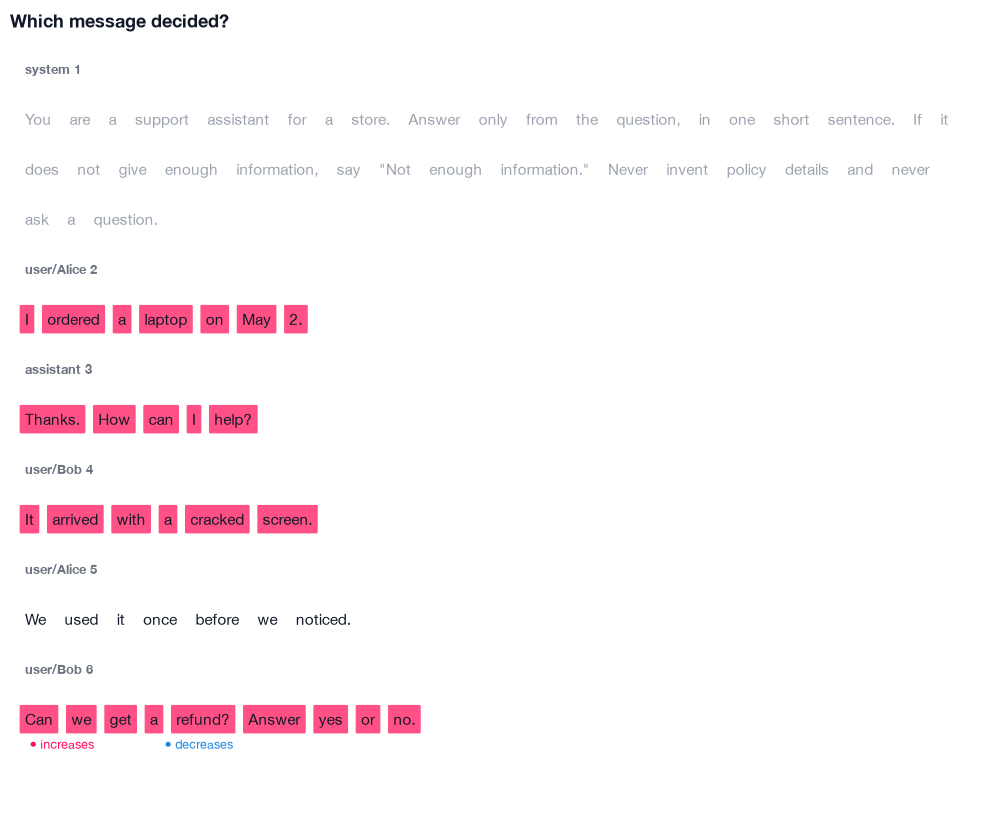
Technical: players: messages makes each message one player, labelled with its role, speaker and position; five players allow exact enumeration (32 coalitions).
thread = ConversationSnapshot.from_turns((
    Turn(messages=(Message(role=Role.SYSTEM, text=SYSTEM),)),
    Turn(messages=(Message(role=Role.USER, speaker="Alice", text="I ordered a laptop on May 2."),)),
    Turn(messages=(Message(role=Role.ASSISTANT, text="Thanks. How can I help?"),)),
    Turn(messages=(Message(role=Role.USER, speaker="Bob", text="It arrived with a cracked screen."),)),
    Turn(messages=(Message(role=Role.USER, speaker="Alice", text="We used it once before we noticed."),)),
    Turn(messages=(Message(role=Role.USER, speaker="Bob", text="Can we get a refund? Answer yes or no."),)),
))
shapley_runner = ExplainRunner(config(estimator="exact", players="messages"), backend=backend)
messages = await shapley_runner.explain(thread)
show(messages)
user/Alice 2: I ordered a laptop on May 2.   +0.250
assistant 3: Thanks. How can I help?         +0.250
user/Bob 4: It arrived with a cracked scre…  +0.250
user/Alice 5: We used it once before we noti +0.000
user/Bob 6: Can we get a refund? Answer ye…  +0.250
sum 1.0 = grand - base 1.0
await answers_without(messages, thread)
                  full input -> 'Yes.'
without user/Alice 2: I orde -> 'No.'
without assistant 3: Thanks. -> 'Not enough information.'
without user/Bob 4: It arriv -> 'Not enough information.'
without user/Alice 5: We use -> 'Yes.'
without user/Bob 6: Can we g -> 'The laptop was returned'
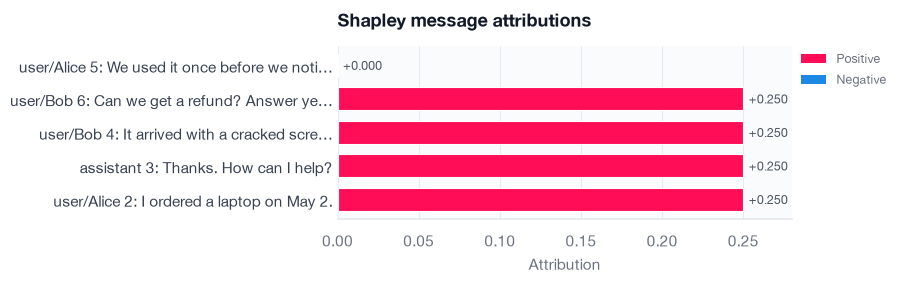
plot_conversation keeps the thread’s shape: one block per message under its role, speaker and position, with each player shaded where it stands. render_conversation_html returns the same view as HTML; hovering a player shows its value.
Words of the users only
Business: reviewers care about what the customers wrote; the assistant’s and system’s text is context, not evidence.
Technical: players: tokens with plugin_options: {tokens: {roles: [user]}} makes only the users’ words players; the system prompt and the assistant message stay present in every coalition and appears grey. The same roles option filters players: messages. 29 word players need a sampled estimator: complementary contributions with 200 evaluations.
user_words = await ExplainRunner(
    config(
        estimator="complementary",
        budget={"evaluations": 200},
        players="tokens",
        plugin_options={"tokens": {"roles": ["user"]}},
    ),
    backend=backend,
).explain(thread)
show(user_words)
Alice: I                                     +0.024
Alice: ordered                               +0.030
Alice: a                                     +0.031
Alice: laptop                                +0.031
Alice: on                                    +0.025
Alice: May                                   +0.024
Alice: 2.                                    +0.023
Bob: It                                      +0.024
Bob: arrived                                 +0.024
Bob: with                                    +0.024
Bob: a                                       +0.024
Bob: cracked                                 +0.067
Bob: screen.                                 +0.030
Alice: We                                    +0.033
Alice: used                                  +0.024
Alice: it                                    +0.030
Alice: once                                  +0.024
Alice: before                                +0.024
Alice: we                                    +0.022
Alice: noticed.                              +0.031
Bob: Can                                     +0.059
Bob: we                                      +0.031
Bob: get                                     +0.024
Bob: a                                       +0.025
Bob: refund?                                 +0.068
Bob: Answer                                  +0.067
Bob: yes                                     +0.066
Bob: or                                      +0.058
Bob: no.                                     +0.033
sum 0.9989 = grand - base 1.0
plot_conversation(user_words, thread, user_words.player_set, title="Which user words decided?")
plt.show()
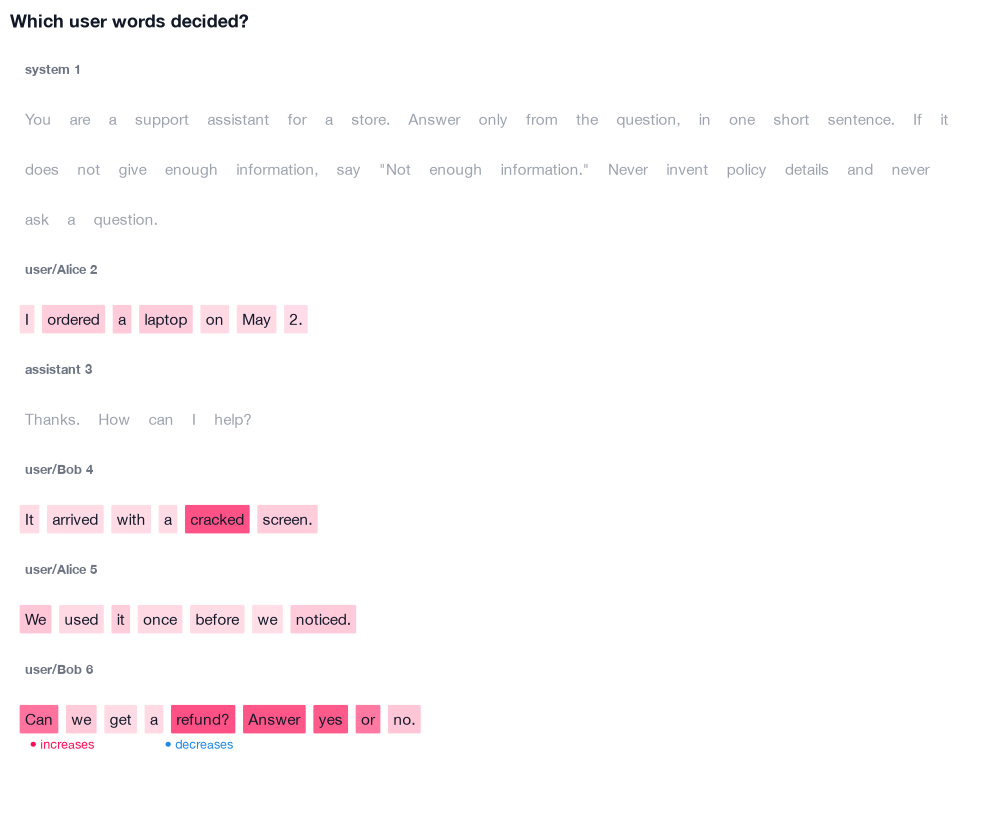
html = render_conversation_html(user_words, thread, user_words.player_set)
print(html.count("mllm-shap-player"), "coloured user words; assistant text kept:", "How can I help?" in html)
29 coloured user words; assistant text kept: True
Renderer classes and Banzhaf values
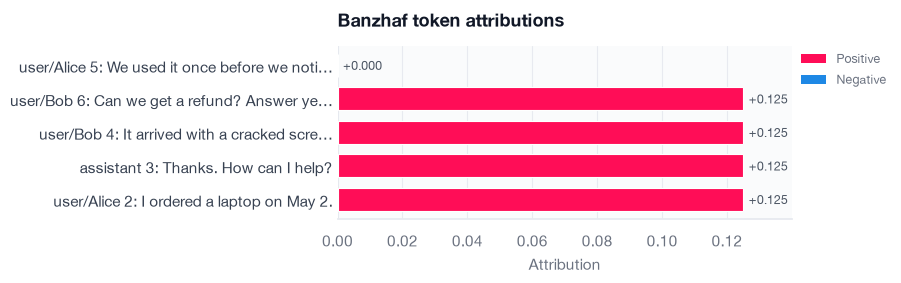
TokenTextRenderer and TokenBarRenderer are the plugin classes behind the renderer names: render(labels, values, estimand=..., title=...) draws any labelled vector, and to_html returns the HTML fragment. With registry=runner.registry, render_attribution resolves renderers you registered yourself. Without title=, the bar chart names the estimand, so a Banzhaf chart is not mistaken for Shapley values; Banzhaf values need not add up.
labels = [span.display_label for span in messages.player_set.spans]
print("to_html matches:", TokenTextRenderer().to_html(labels, messages.result.values,
      estimand=messages.result.estimand) == render_attribution_html(messages, thread, messages.player_set))
banzhaf_runner = ExplainRunner(
    config(estimator="exact", estimand="banzhaf", players="messages"), backend=backend
)
banzhaf = await banzhaf_runner.explain(thread)
show(banzhaf)
TokenBarRenderer().render(labels, banzhaf.result.values, estimand=banzhaf.result.estimand)
plt.show()
to_html matches: True
user/Alice 2: I ordered a laptop on May 2.   +0.125
assistant 3: Thanks. How can I help?         +0.125
user/Bob 4: It arrived with a cracked scre…  +0.125
user/Alice 5: We used it once before we noti +0.000
user/Bob 6: Can we get a refund? Answer ye…  +0.125
sum 0.5 = grand - base 1.0
Spoken words
Business: a voice assistant hears a sentence; which spoken words shaped its reading of the speaker’s mood?
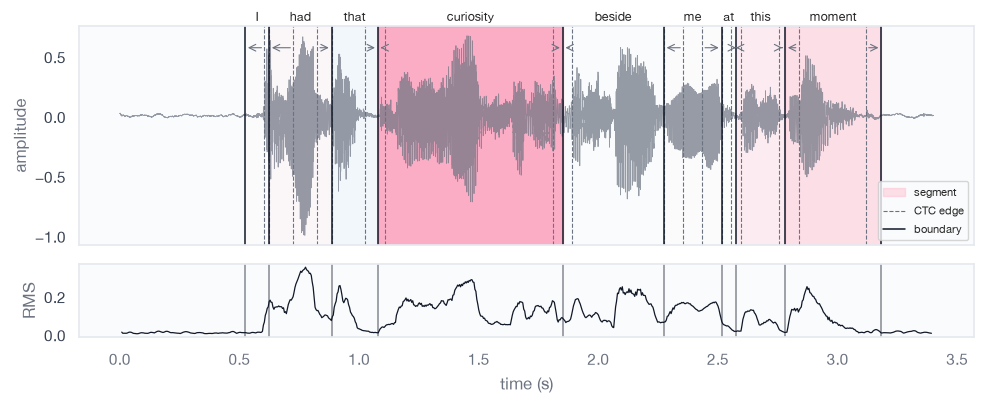
Technical: players: sgpa_segments aligns the recording (voices_sp0307.wav, VOiCES corpus, CC BY 4.0) to its transcript and makes each spoken word a player whose audio and text are masked together. No backend generates from audio yet, so a small wrapper hands the model the masked transcript.
class TranscriptReader:
    """Give the text model the masked transcript of each audio message."""

    model_id = backend.model_id

    async def generate(self, snapshot, generation):
        text_only = ConversationSnapshot.from_turns(tuple(
            Turn(messages=tuple(
                Message(role=m.role, text=m.text, speaker=m.speaker) for m in turn.messages
            ))
            for turn in snapshot.turns
        ))
        return await backend.generate(text_only, generation)


clip = AudioPart(Path("voices_sp0307.wav"), sample_rate=16000)
spoken = ConversationSnapshot.from_turns((Turn(messages=(
    Message(role=Role.SYSTEM, text=SYSTEM),
    Message(role=Role.USER, text="How did the speaker feel? Answer in one word."),
    Message(role=Role.USER, content=(TextPart("I had that curiosity beside me at this moment"), clip)),
)),))
audio_config = config(
    estimator="complementary", budget={"evaluations": 128}, players="sgpa_segments",
    plugin_options={"sgpa_segments": {
        "model_id": "facebook/wav2vec2-base-960h",
        "revision": "22aad52d435eb6dbaf354bdad9b0da84ce7d6156",
    }},
)
heard = await ExplainRunner(audio_config, backend=TranscriptReader()).explain(spoken)
show(heard)
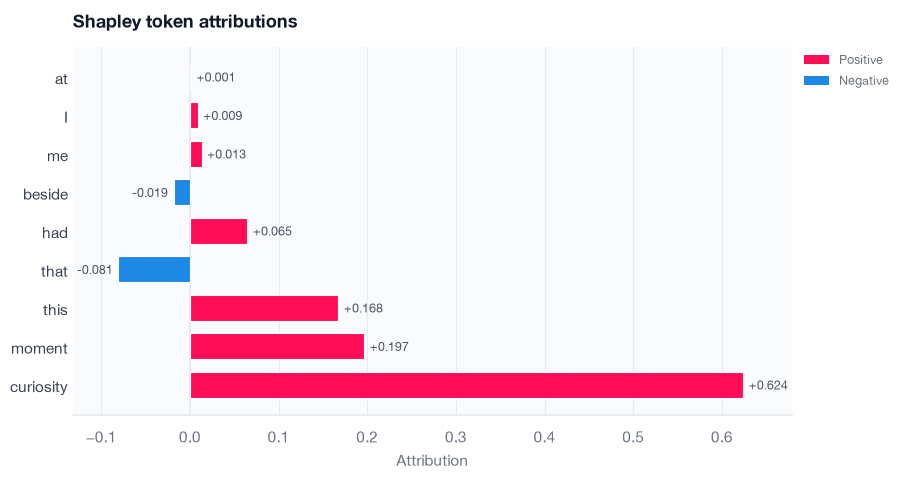
I                                            +0.009
had                                          +0.065
that                                         -0.081
curiosity                                    +0.624
beside                                       -0.019
me                                           +0.013
at                                           +0.001
this                                         +0.168
moment                                       +0.197
sum 0.9776 = grand - base 1.0
plot_audio_segments draws each word’s stretch of audio coloured by its value, over the waveform and its energy; token_bar ranks the same players.
from mllm_shap.alignment import SpectrogramGuidedAligner, Wav2Vec2Ctc

aligner = SpectrogramGuidedAligner(Wav2Vec2Ctc(
    "facebook/wav2vec2-base-960h", revision="22aad52d435eb6dbaf354bdad9b0da84ce7d6156"))
segments = aligner.align("I had that curiosity beside me at this moment", clip)
plot_audio_segments(clip, segments, values=list(heard.result.values))
plt.show()
render_attribution(heard, spoken, heard.player_set, renderer="token_bar")
plt.show()
Typed and spoken words together
Business: the question was typed and the answer spoken; which words, of either kind, shaped the reply?
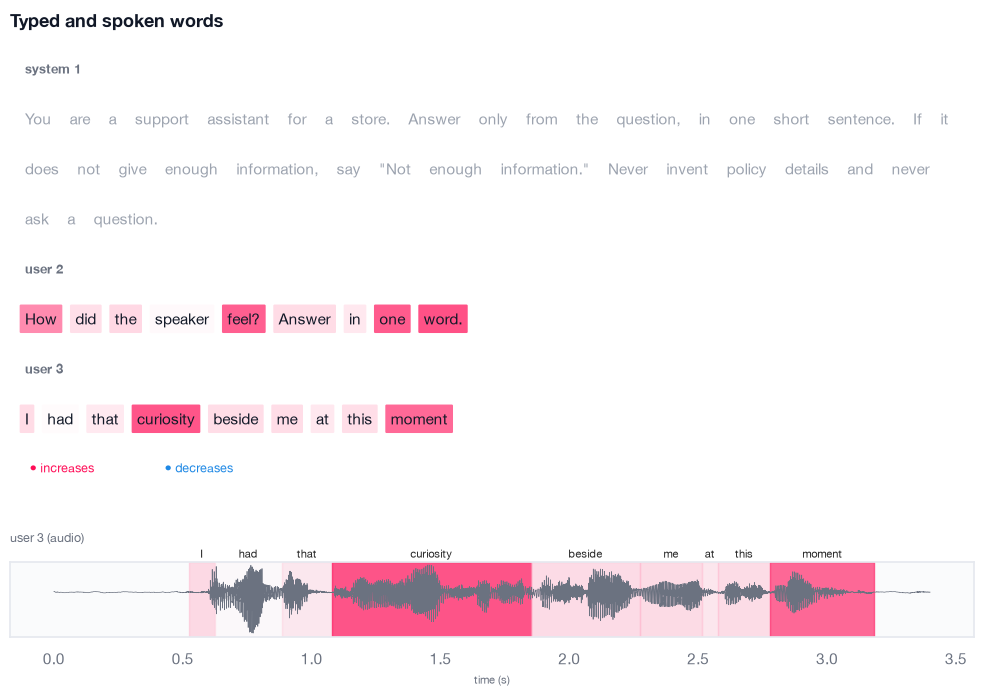
Technical: the sgpa_segments option text_roles: [user] also makes the words of the typed user message players, so both kinds share one run and one colour scale (18 players, complementary contributions with 240 evaluations). plot_conversation shows the typed words in place and adds a waveform strip for the spoken message, shaded on the same scale.
mixed_config = config(
    estimator="complementary", budget={"evaluations": 240}, players="sgpa_segments",
    plugin_options={"sgpa_segments": {
        "model_id": "facebook/wav2vec2-base-960h",
        "revision": "22aad52d435eb6dbaf354bdad9b0da84ce7d6156",
        "text_roles": ["user"],
    }},
)
mixed = await ExplainRunner(mixed_config, backend=TranscriptReader()).explain(spoken)
show(mixed)
plot_conversation(mixed, spoken, mixed.player_set, title="Typed and spoken words")
plt.show()
How                                          +0.091
did                                          +0.037
the                                          +0.044
speaker                                      +0.009
feel?                                        +0.111
Answer                                       +0.041
in                                           +0.029
one                                          +0.113
word.                                        +0.117
I                                            +0.041
had                                          +0.006
that                                         +0.028
curiosity                                    +0.116
beside                                       +0.039
me                                           +0.040
at                                           +0.029
this                                         +0.039
moment                                       +0.107
sum 1.0351 = grand - base 1.0