End-to-end text explainability on real backends
Business context: product and policy teams need to see which prompt words drive a model answer before shipping a refund assistant. This notebook explains one question with each built-in model backend.
Goal: explain the same snapshot with the config/ presets: LM Studio, Hugging Face transformers (with the prefix KV cache, backend.options.dtype and a pinned revision) and the OpenAI-compatible HTTP API backend; check efficiency and render every result.
Prerequisites: a clone of the repository and pip install "mllm-shap[transformers,api,viz]". LM Studio also needs mllm-shap[lmstudio] and a server with qwen2-500m-instruct loaded (MLLM_SHAP_LMSTUDIO_MODEL); without one, that section prints why it was skipped. Transformers downloads HuggingFaceTB/SmolLM2-360M-Instruct (about 720 MB; MLLM_SHAP_E2E_MODEL), small enough for a CPU. The API section runs offline against an in-process stand-in.
Expected output: per backend, efficient values, scheduler metrics and two charts; identical transformers values with the KV cache on and off.
import json
import os
import re
from pathlib import Path

import httpx
import matplotlib.pyplot as plt

from mllm_shap import (
    ApiBackend,
    BackendUnavailableError,
    CoalitionMask,
    ConversationSnapshot,
    DeletePolicy,
    ExplainConfig,
    ExplainRunner,
    ExplainRunOutput,
    Message,
    PluginContext,
    Role,
    TransformersTextBackend,
    Turn,
    explain_config_from_yaml,
    render_attribution,
)

# Quiet Hugging Face download progress bars and advisory warnings.
os.environ.setdefault("HF_HUB_DISABLE_PROGRESS_BARS", "1")
os.environ.setdefault("HF_HUB_VERBOSITY", "error")
os.environ.setdefault("TRANSFORMERS_VERBOSITY", "error")

try:
    import lmstudio as lms
except ImportError:  # optional extra: mllm-shap[lmstudio]
    lms = None
LM Studio backend
Business: A local LM Studio server keeps prompts on the analyst’s machine, which matters for confidential tickets.
Technical: The lmstudio backend talks to the LM Studio server through the lmstudio SDK; dev_lmstudio.yaml sets backend.options.serialize_generate: true so coalitions are generated one at a time. The cell looks for a running server first and prints why the section is skipped when the extra or the server is missing; the stored output below comes from the machine that last executed the notebook.
lmstudio_output = None
if lms is None:
    print(
        "Skipped: the lmstudio extra is not installed "
        "(pip install 'mllm-shap[lmstudio]')."
    )
else:
    host = await lms.AsyncClient.find_default_local_api_host()
    if host is None or not await lms.AsyncClient.is_valid_api_host(host):
        print(
            "Skipped: no LM Studio server found; "
            f"start it and load {LMSTUDIO_MODEL_ID}."
        )
    else:
        config = preset(
            "dev_lmstudio.yaml",
            backend={"model_id": LMSTUDIO_MODEL_ID, "api_host": host},
        )
        try:
            lmstudio_output = await ExplainRunner(config).explain(snapshot)
        except BackendUnavailableError as exc:
            print(f"Skipped: {exc}")
if lmstudio_output is not None:
    report("LM Studio", lmstudio_output)
LM Studio
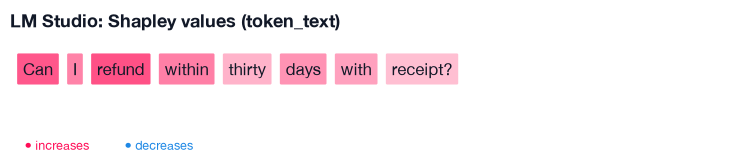
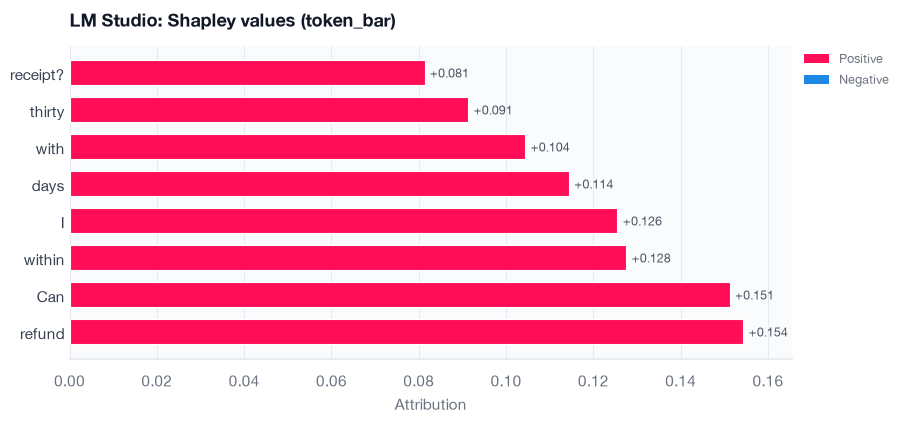
        Can +0.1512
          I +0.1255
     refund +0.1543
     within +0.1275
     thirty +0.0913
       days +0.1144
       with +0.1044
   receipt? +0.0813
  sum of values: 0.94998
  grand - base:  0.94998
  SchedulerMetrics(requested=256, executed=255, deduplicated=0, cache_hits=1, kv_cache_hits=0, kv_cache_reused_tokens=0)
Transformers backend
Business: An in-process model gives full control over weights and versions; pinning the Hub revision makes a rerun months later load the same weights.
Technical: dev_transformers.yaml enables explanation.kv_cache: every prompt shares a prefix with an earlier one, and the backend reuses the cached key/value states of the longest cached prefix instead of recomputing them (kv_cache_hits and kv_cache_reused_tokens count the reuse). backend.options.revision pins the Hub commit; backend.options.dtype (auto, float32, float16, bfloat16) picks the weight type, and float32 here keeps the greedy answers identical on CPU, CUDA and Apple MPS (auto would pick bfloat16 on accelerators that support it). The second run switches the cache off: greedy outputs do not depend on it, so the values must match exactly.
transformers_options = {"dtype": "float32"}
if TRANSFORMERS_MODEL_ID == DEFAULT_MODEL_ID:
    transformers_options["revision"] = DEFAULT_REVISION
transformers_output = None
try:
    transformers_config = preset(
        "dev_transformers.yaml",
        backend={"model_id": TRANSFORMERS_MODEL_ID, "options": transformers_options},
        generation={"max_new_tokens": 24},
    )
    transformers_backend = TransformersTextBackend(
        PluginContext(config=transformers_config)
    )
    transformers_output = await ExplainRunner(
        transformers_config, backend=transformers_backend
    ).explain(snapshot)
    no_cache_output = await ExplainRunner(
        preset(
            "dev_transformers.yaml",
            backend={
                "model_id": TRANSFORMERS_MODEL_ID,
                "options": transformers_options,
            },
            generation={"max_new_tokens": 24},
            explanation={"kv_cache": {"enabled": False}},
        )
    ).explain(snapshot)
except (BackendUnavailableError, ImportError) as exc:
    print(f"Skipped: {exc}")
if transformers_output is not None:
    report("Transformers (KV cache on)", transformers_output)
    print("KV cache off:", no_cache_output.metrics)
    print(
        "identical values with and without the cache:",
        no_cache_output.result.values == transformers_output.result.values,
    )
Transformers (KV cache on)
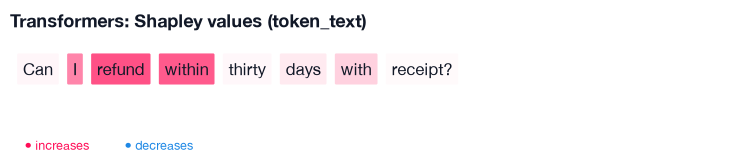
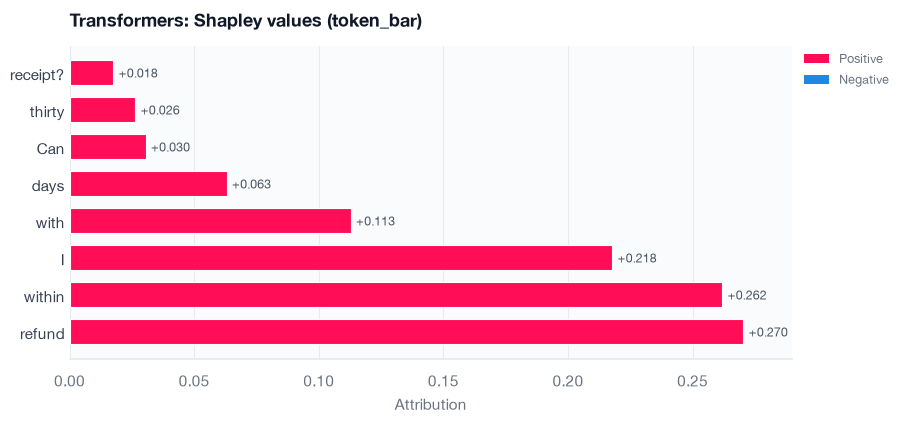
        Can +0.0305
          I +0.2177
     refund +0.2703
     within +0.2619
     thirty +0.0264
       days +0.0630
       with +0.1128
   receipt? +0.0175
  sum of values: 1.0
  grand - base:  1.0
  SchedulerMetrics(requested=256, executed=255, deduplicated=0, cache_hits=1, kv_cache_hits=254, kv_cache_reused_tokens=16227)
KV cache off: SchedulerMetrics(requested=256, executed=255, deduplicated=0, cache_hits=1, kv_cache_hits=0, kv_cache_reused_tokens=0)
identical values with and without the cache: True
What the model answers. Each value summarises answers like these: the full question, then the question with one word deleted. A word matters when its absence changes the answer.
if transformers_output is not None:
    players = transformers_output.player_set
    generation = transformers_config.generation
    full = await transformers_backend.generate(snapshot, generation)
    print(f"{'full question':>18} -> {full.text!r}")
    for index, span in enumerate(players.spans):
        mask = CoalitionMask.from_sequence(
            tuple(other != index for other in range(players.num_players))
        )
        absent = DeletePolicy().apply(snapshot, players, mask)
        answer = await transformers_backend.generate(absent, generation)
        print(f"{'without ' + span.text:>18} -> {answer.text!r}")
     full question -> 'Yes, you can refund within thirty days with a receipt.'
       without Can -> 'Yes, I can refund within thirty days with a receipt.'
         without I -> 'Yes, refunds can be made within thirty days with a receipt.'
    without refund -> 'Yes, you can within thirty days with receipt.'
    without within -> 'Yes, you can return the product within thirty days of purchase with a receipt.'
    without thirty -> 'Yes, you can refund within days with a receipt.'
      without days -> 'Yes, you can refund within thirty days with a receipt.'
      without with -> 'Yes, you can refund within thirty days receipt.'
  without receipt? -> 'Yes, you can refund within thirty days.'
SmolLM2 answers the question; masking refund or within (and the pronoun I) changes that answer most. A 360M model is a weak judge, so read the ranking as a demonstration. The values add up to grand_value - base_value, the grand coalition reuses the base generation (the one cache hit), and almost every coalition reuses a cached prefix.
OpenAI-compatible HTTP API backend
Business: hosted models (OpenAI, vLLM, LM Studio in server mode) speak the same chat-completions protocol; retries and timeouts decide whether a long run survives a flaky network.
Technical: the api backend posts each coalition to <api_host>/chat/completions and retries transient failures (status codes, backoff and API keys: backends guide). Here an httpx.MockTransport plays the server: it fails the first request with 503, then answers from keywords like the stand-in of explain_pipeline.ipynb. async with closes the injected backend; for a real server, drop transport= and point api_host at it.
requests_seen = []


def openai_stand_in(request: httpx.Request) -> httpx.Response:
    """Answer chat completions from keywords; fail the first request with 503."""
    requests_seen.append(request)
    if len(requests_seen) == 1:
        return httpx.Response(503, headers={"Retry-After": "0"})
    prompt = json.loads(request.content)["messages"][-1]["content"]
    words = set(re.findall(r"[a-z]+", prompt.lower()))
    phrases = [
        p
        for k, p in (("refund", "refund approved"), ("receipt", "receipt checked"))
        if k in words
    ]
    reply = " ".join(phrases) or "please clarify"
    return httpx.Response(
        200, json={"choices": [{"message": {"role": "assistant", "content": reply}}]}
    )


api_config = preset(
    "dev_api.yaml", backend={"api_host": "http://stand-in.local/v1", "max_retries": 1}
)
api_backend = ApiBackend(
    PluginContext(config=api_config), transport=httpx.MockTransport(openai_stand_in)
)
async with ExplainRunner(api_config, backend=api_backend) as api_runner:
    api_output = await api_runner.explain(snapshot)
print("HTTP requests:", len(requests_seen), "(one retried after the 503)")
report("HTTP API", api_output)
HTTP requests: 257 (one retried after the 503)
HTTP API
        Can +0.0000
          I +0.0000
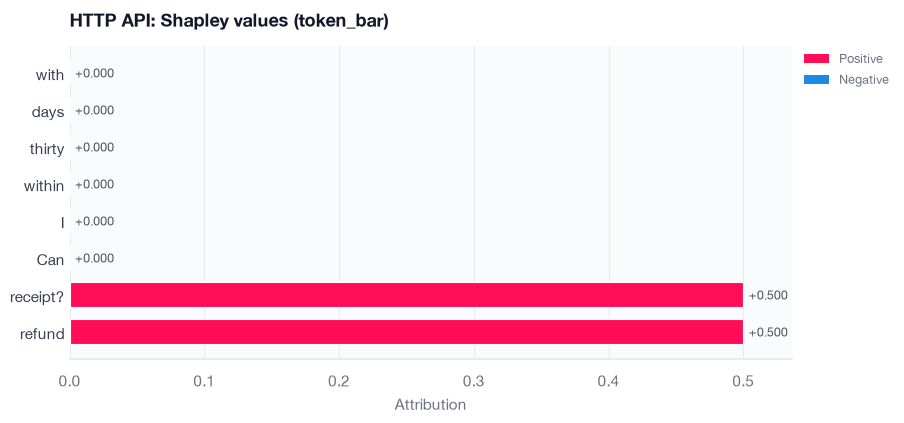
     refund +0.5000
     within +0.0000
     thirty +0.0000
       days +0.0000
       with +0.0000
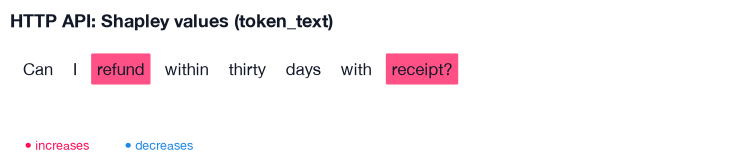
   receipt? +0.5000
  sum of values: 1.0
  grand - base:  1.0
  SchedulerMetrics(requested=256, executed=255, deduplicated=0, cache_hits=1, kv_cache_hits=0, kv_cache_reused_tokens=0)
The stand-in only reacts to refund and receipt?, so the two words share the value equally and the other six get 0. Every coalition is a distinct prompt, so the backend sent one request per executed coalition (the grand coalition reuses the base answer) plus two for the base generation: the 503 and its retry.
Visual comparison
Technical: render_attribution draws the result with a renderer plugin (token_text colours the words, token_bar sorts them by impact); output.player_set holds the players the run explained.
for label, output in (
    ("LM Studio", lmstudio_output),
    ("Transformers", transformers_output),
    ("HTTP API", api_output),
):
    if output is None:
        print(f"{label}: skipped above, nothing to draw.")
        continue
    for renderer in ("token_text", "token_bar"):
        render_attribution(
            output,
            snapshot,
            output.player_set,
            renderer=renderer,
            title=f"{label}: Shapley values ({renderer})",
        )
        plt.show()